
What molecule am I?

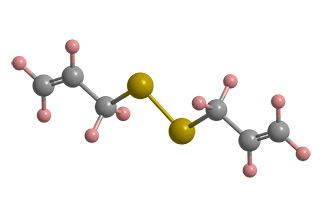
The natural product diallyl disulfide is the major constituent of oil of garlic (Allium sativum) and other members of the Allium genus, including onion (A. cepa). It is responsible for garlic’s characteristic odor.
Efforts to identify the active compound in garlic began in the mid-1800s; but it was not until a century later (1945) that Chester J. Cavallito, John Hays Bailey, and Johannes S. Buck at Winthrop Chemical Co. (Rensselaer, NY) described the “antibacterial principle of A. sativum”, which they derived from the “essential oil of garlic”. The researchers found that diallyl disulfide is biosynthesized via the enzymatic reduction of its S-oxide, allicin1, the Molecule of the week for October 7, 2024.
Diallyl disulfide is not only responsible for the enjoyment of garlic, but it also has beneficial health effects. In 1988, Chung S. Yang and co-workers at the University of Medicine and Dentistry of New Jersey (Newark) and Rutgers University (Piscataway, NJ), following up on reports that diallyl disulfide inhibits 1,2-dimethylhydrazine2-induced colon and liver cancer in rodents, suggested a possible mechanism for this effect. They proposed that the disulfide could inhibit hepatic activation of the procarcinogen by suppressing the action of P450IIE1, an isozyme of cytochrome P-450 that promotes the oxidative metabolism of dimethylhydrazine. Tests on rats showed that diallyl disulfide decreased the activity of a key enzyme, and thus the level of P450IIE1, by 80% compared with controls.
Diallyl disulfide has also been shown to prevent colon cancer. In chapter 12 of Food Phytochemicals for Cancer Prevention I (1993), Bandaru S. Reddy and Chinthalapally V. Rao at the American Health Foundation (Valhalla, NY) examined the results of previous epidemiological studies that suggested that consuming garlic and cruciferous vegetables rich in organosulfur compounds is associated with a reduced risk for cancers, particularly colon cancer. They dosed rats that had azoxymethane3-induced colon cancer with diallyl disulfide and two other dietary organosulfur compounds, oltipraz4 and anethole trithione5, and found that all three “significantly inhibited colon carcinogenesis in a dose-dependent manner”.
1. CAS Reg. No. 539-86-6.
2. CAS Reg. No. 540-73-8.
3. CAS Reg. No. 25843-45-2.
4. CAS Reg. No. 64224-21-1.
5. CAS Reg. No. 532-11-6.
Diallyl disulfide hazard information*
| Hazard class** | GHS code and hazard statement | |
|---|---|---|
| Flammable liquids, category 3 | H226—Flammable liquid and vapor | 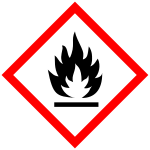 |
| Acute toxicity, oral, category 3 | H301—Toxic if swallowed | 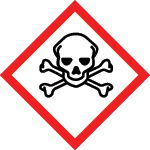 |
| Skin corrosion/irritation, category 2 | H315—Causes skin irritation |  |
| Skin sensitization, category 1 | H317—May cause an allergic skin reaction | |
| Serious eye damage/eye irritation, category 2A | H319—Causes serious eye irritation | |
| Specific target organ toxicity, single exposure, respiratory tract irritation, category 3 | H335—May cause respiratory irritation | |
*Compilation of multiple safety data sheets. Where hazard statements disagree, the greater hazard is shown.
**Globally Harmonized System (GHS) of Classification and Labeling of Chemicals. Explanation of pictograms.
This molecule was suggested by a reader. We present almost all of the molecules suggested by our readers. If you have a molecule that you would like us to consider, please send us a message, preferably including links to references about your suggested molecule. And thank you for your interest in Molecule of the Week! —Ed.
Diallyl disulfide
fast facts
| CAS Reg. No. | 2179-57-9 |
| SciFinder name | Disulfide, di-2- propen-1-yl |
| Empirical formula | C6H10S2 |
| Molar mass | 146.28 g/mol |
| Appearance | Oily yellow liquid |
| Boiling point | 180–195 ºCa |
| Water solubility | ≈70 mg/L (20 ºC) |
a. Literature reports vary widely.
Learn more about this molecule from CAS, the most authoritative and comprehensive source for chemical information.
Molecule of the Week needs your suggestions!
If your favorite molecule is not in our archive, please send us a message. The molecule can be notable for its current or historical importance or for any quirky reason. Thank you!
Stay Ahead of the Chemistry Curve
Learn how ACS can help you stay ahead in the world of chemistry.
