What molecule am I?


Arsphenamine, aka salvarsan, is considered to be the first chemotherapeutic drug. It was developed to combat syphilis and other infectious diseases in the early 1910s by Paul Ehrlich*1 and co-inventors Alfred Bertheim and Baptist Reuter at Farbwerke vorm. Meister Lucius & Brüning2 (Höchst, Germany) and described in US Patents 986,148 (1911) and 1,078,135 (1913). During 1910–13, Ehrlich also published several journal articles on what he initially called “compound 606”.
A word on nomenclature: The dihydrochloride of 4,4’-(1,2-diarsenediyl)bis(2-aminophenol) is conventionally called arsphenamine. The free diamine3 is sometimes also called arsphenamine, but it also goes by arsphenolamine.
Although the structure of arsphenamine is usually depicted with an arsenic–arsenic double bond, in 2005, an electrospray ionization mass spectrometric study by Brian K. Nicholson and co-workers at the University of Waikato (Hamilton, New Zealand) found that no As=As bonds were present. Instead, the chemists observed As–As single bonds that formed rings consisting of three or five arsenic atoms.
Soon after his original discovery, Ehrlich developed a derivative of arsphenamine called neoarsphenamine or neosalvarsan4. The new compound had a hydrogen sulfoxylmethyl (HOSOCH2–) group attached to one of its amino groups and was less toxic and more water-soluble than the parent compound. It was equally effective against syphilis and other diseases, according to dozens of accounts published in 1912–13, although some authors cautioned against toxic overdoses that can result from its high solubility. In a 1912 article, G. Castelli at Georg-Speyer-Haus (Frankfort-am-Main, Germany) reported that neosalvarsan successfully treated rabbits experiencing generalized syphilis and generalized frambesia.
Because all arsenic-containing drugs carry the risk of toxicity, arsphenamine and neoarsphenamine were replaced in the 1940s by penicillin and similar medications. But the breakthrough arsenicals continue to be the subjects of laudatory articles. Examples include Amanda Yarnell’s 2005 story in C&EN and a 2009 account of Ehrlich’s “magic bullet” by British author K. J. Williams.
Because it is no longer an article of commerce, no safety data sheets for arsphenamine are available. The National Library of Medicine’s Pubchem datasheet, however, considers it carcinogenic, as are almost all arsenic compounds. It also lists several other adverse health effects.
For further reading, see ScienceDirect’s extensive topics page on arsphenamine.
1. Ehrlich had previously shared the 1908 Nobel Prize in Physiology or Medicine for his work on the theory of immunity.
2. Forerunner of Hoechst AG.
3. CAS Reg. No. 150-44-7.
4. CAS Reg. No. 457-60-3.
(+)-Carbamorphine1 is an analogue of the analgesic morphine2 with a methylene group substituted for the ring oxygen atom. Susruta Majumdar at Washington University (St. Louis), Richmond Sarpong at the University of California, Berkeley, and collaborators at these and other American universities designed and synthesized the molecule with the intent of avoiding morphine’s adverse side effects such as addiction and respiratory depression.
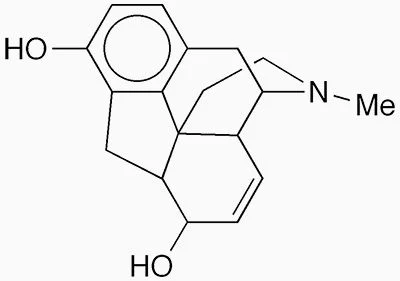
The synthesis of carbamorphine wasn’t easy. It took 15 steps beginning from 4-methoxy-1-indanone3, including an intramolecular inverse electron-demand Diels−Alder cycloaddition and a stereoselective Giese radical addition.
Morphine and carbamorphine are µ-opioid receptor (MOR) agonists. Whereas only the (–)-morphine enantiomer binds the MOR, both carbamorphine enantiomers bind the receptor. The researchers used (+)-carbamorphine in mouse experiments in which the compound exhibited MOR-selective antinociception (pain reduction), a lack of conditioned place preference (addiction), and reduced respiratory depression.
1. CAS Reg. No. 3128017-17-1.
2. CAS Reg. No. 57-27-2.
3. CAS Reg. No. 13336-31-7.
Molecule of the Future
Periodically we bring you a newly discovered or developed molecule that has important implications for the future of chemistry or society in general. Learn more about this week's Molecule of the Future.
Molecule of the Week wants your suggestions!
If your favorite molecule is not already featured in our archive, please send us your recommendation. We welcome molecules that are noteworthy for their historical or current importance, scientific impact, or unique characteristics. Thank you for your contribution!
Arsphenamine
fast facts
| CAS Reg. No. | 139-93-5 |
| SciFinder name | Phenol, 4,4’-(1,2- diarsenediyl)bis[2- amino-, hydrochloride |
| Empirical formula | C12H14As2Cl2N2O2 |
| Molar mass | 439.00 g/mol |
| Appearance | Yellow crystals or powder |
| Melting point | ≈190 °C (dec.) |
| Water solubility | Slight |
Learn more about this molecule from CAS, the most authoritative and comprehensive source for chemical information.
Molecule of the Week needs your suggestions!
If your favorite molecule is not in our archive, please send us a message. The molecule can be notable for its current or historical importance or for any quirky reason. Thank you!
Stay Ahead of the Chemistry Curve
Learn how ACS can help you stay ahead in the world of chemistry.
