What molecule am I?

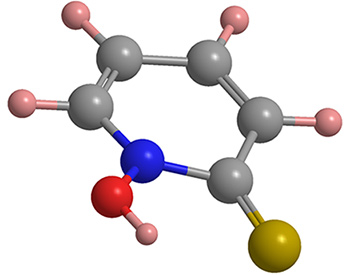
Pyrithione is a heterocyclic compound that exists as two tautomers. The predominant one, shown, contains a thione group and a hydroxyl group. Its tautomer has thiol and nitrogen oxide functionalities.
Pyrithione occurs naturally in the Persian shallot (Allium stipitatum), a member of the onion and garlic family. It has been known since early in the 20th century; but its first appearance in the chemical literature came in 1950, when Elliott Shaw and co-workers at the Squibb Institute for Medical Research (New Brunswick, NJ) reported its synthesis in an article about analogues of aspergillic acid1.
Shaw et al. prepared pyrithione in two ways: (1) by the oxidation of 2-bromopyridine2 to its N-oxide3 and then displacing the bromine atom with sulfide; or (2) by treating 2-bromopyridine-N-oxide with thiourea, followed by aqueous sodium carbonate.
Pyrithione is used primarily as a fungicide and bactericide; but its main attraction for chemists is its ability to form complexes with metals, particularly zinc. Zinc pyrithione4 has widespread commercial use as the active ingredient in anti-dandruff shampoos.
In 2022, Maria J. Buzon at the Autonomous University of Barcelona, Iztok Turel at the University of Ljubljana (Slovenia), and colleagues at both institutions reported a promising medical application for zinc pyrithione. They found that the complex is a potent inhibitor of papain-like protease (PLpro), an enzyme encoded by coronaviruses such as SARS-CoV-2. It also inhibits cathepsin L enzymes, which are involved with SARS-CoV-2 replication. The authors believe that zinc pyrithione could be a safe, effective, readily-available, and preferably oral at-home therapeutic for COVID-19.
1. CAS Reg. No. 28696-18-6.
2. CAS Reg. No. 109-04-6.
3. CAS Reg. No. 14305-17-0.
4. CAS Reg. No. 13463-41-7; Molecule of the Week for February 11, 2014.
Pyrithione hazard information*
| Hazard class** | GHS code and hazard statement | |
|---|---|---|
| Acute toxicity, oral, category 4 | H302—Harmful if swallowed | 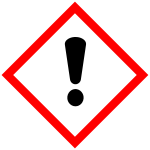 |
| Acute dermal toxicity, category 4 | H312—Harmful in contact with skin | |
| Skin corrosion/irritation, category 2 | H315—Causes skin irritation | |
| Serious eye damage/eye irritation, category 2A | H319—Causes serious eye irritation | |
| Acute inhalation toxicity, dusts and mists, category 4 | H332—Harmful if inhaled | |
| Specific target organ toxicity, single exposure; respiratory tract irritation, category 3 | H335—May cause respiratory irritation | |
*Compilation of multiple safety data sheets.
**Globally Harmonized System (GHS) of Classification and Labeling of Chemicals. Explanation of pictograms.
Molecule in the News
Phenibut1 (4-amino-3-phenylbutyric acid or β-phenyl-γ-aminobutyric acid) is a phenyl derivative of the mammalian neurotransmitter γ-aminobutyric acid2 (GABA). Its synthesis was first reported in 1954 by Vsevolod V. Perekalin* and A. S. Sopova at the A. I. Herzen Leningrad Pedagogical Institute (USSR; now Herzen University, St. Petersburg) who prepared it in three steps from β-nitrostyrene3 and diethyl malonate4.
In 2006, Izyaslav Lapin at Bekhterev’s Psychoneurological Institute (St. Petersburg) published an account of phenibut as a tranquilizer and nootropic (cognition-enhancing) drug. According to the author, phenibut acts as a GABA mimetic, primarily at the GABAB receptor. He noted that “Phenibut is widely used in Russia to relieve tension, anxiety, and fear [and] to improve sleep in psychosomatic or neurotic patients,” among other uses. (Phenibut is not legal in the United States, but products containing phenibut are readily available.)
In August, Sandra McDonald at the Los Angeles Times wrote that the Los Angeles City Council voted to regulate phenibut, which it called a “gas station drug”. The unregulated compound is being sold as a “brain booster” or “smart drug” and is widely available in convenience stores. It is marketed directly to children for anxiety, depression, and other psychological disorders; but it can lead to addiction, seizures, psychosis, and even death.
1. CAS Reg. No. 1078-21-3.
2. CAS Reg. No. 56-12-2.
3. CAS Reg. No. 102-96-5.
4. CAS Reg. No. 105-53-3.
Molecule in the News
MOTW highlights molecules that appear in major news outlets. See this week's edition.
Molecule of the Week wants your suggestions!
If your favorite molecule is not already featured in our archive, please send us your recommendation. We welcome molecules that are noteworthy for their historical or current importance, scientific impact, or unique characteristics. Thank you for your contribution!
Pyrithione fast facts
| CAS Reg. No. | 1121-30-8 |
| SciFinder name | 2(1H)- Pyridinethione, 1-hydroxy- |
| Empirical formula | C5H5NOS |
| Molar mass | 127.17 g/mol |
| Appearance | Beige crystals or powder |
| Melting point | 70–73 °C |
| Water solubility | 2.5 g/L (20 °C) |
Learn more about this molecule from CAS, the most authoritative and comprehensive source for chemical information.
Molecule of the Week needs your suggestions!
If your favorite molecule is not in our archive, please send us a message. The molecule can be notable for its current or historical importance or for any quirky reason. Thank you!
Stay Ahead of the Chemistry Curve
Learn how ACS can help you stay ahead in the world of chemistry.
